
Card Centering Explained: What We Learned Measuring 200+ Graded Cards
We measured centering on 200+ graded cards, front and back. Only 44% of fronts made 55/45 for a 10. How centering is measured, print skew, and our system.
Shane Elmer
Author
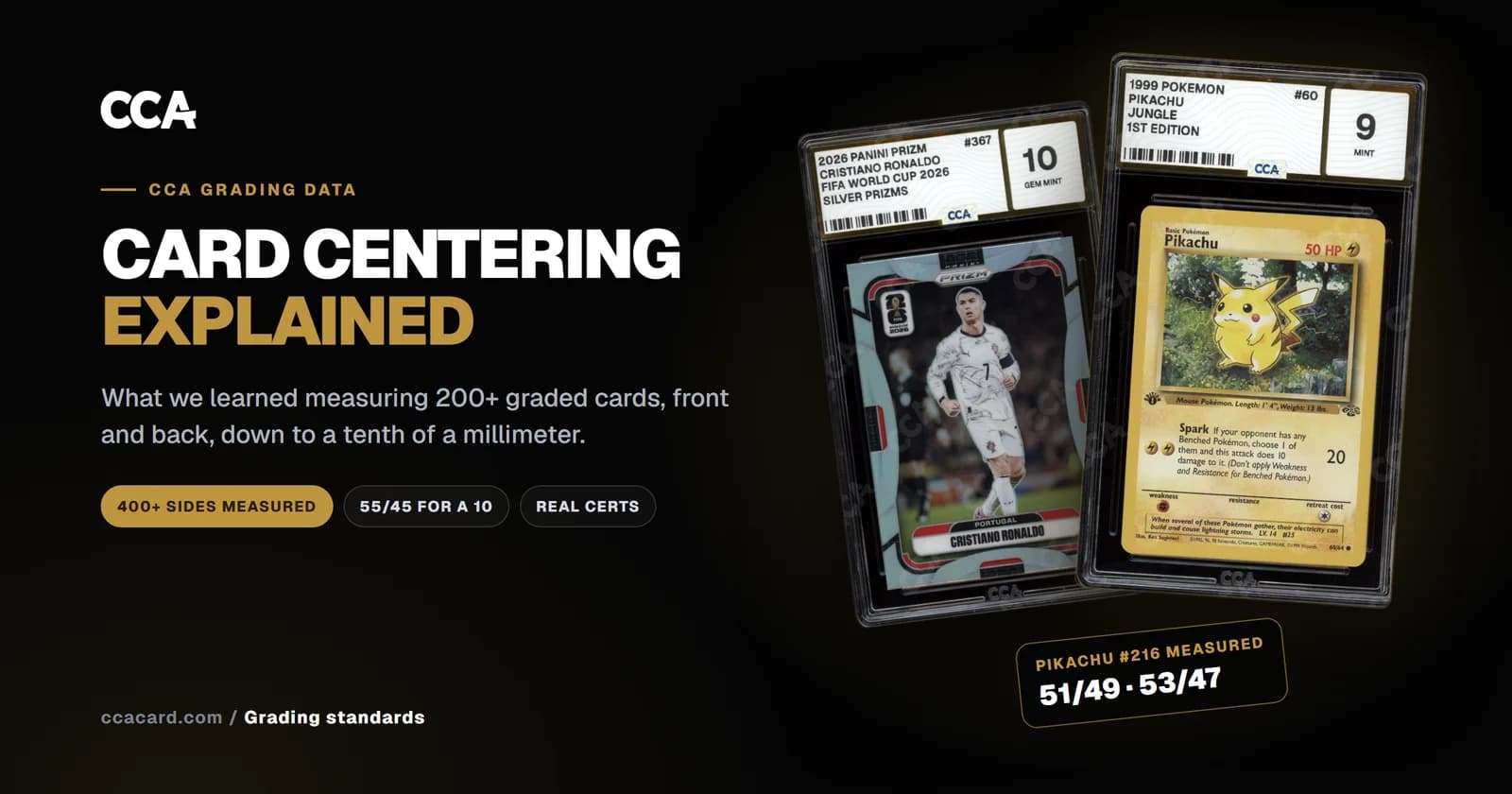
Centering is the one part of a grade you can measure with a ruler, which is exactly why it causes so many arguments. A card can look perfect in hand and still miss a 10 by less than a millimeter.
So we looked at our own numbers. Every card we grade today is scanned at 300 DPI and measured, front and back, and a grader reviews every measurement before the grade is saved. As of October 8, 2026 that is 200+ graded cards and 400+ measured sides: Pokémon, One Piece, Dragon Ball Super, baseball, basketball, football, soccer and more, from a 1978 release to cards printed this year. This post walks through how centering is measured, what those cards showed, and how our measurement system works.
At a glance
- Only 44% of fronts were centered 55/45 or better, the cutoff for a 10 in centering. 88% made 60/40.
- On an average card, a 55/45 split means one border is about 0.86 mm wider than the other side to side, and about 0.64 mm top to bottom.
- Top/bottom was the worse axis more often than left/right (109 cards to 79).
- Trading card games centered better than sports cards (54% vs 40% made 55/45), and cards from 2015 on beat cards from the 1990s (52% vs 28%).
- Print skew is real but small: the average printed frame sat 0.06° off the cut, and the worst was 0.65°.
What centering actually measures
Centering compares two outlines on the same side of a card:
- the cut edge, the physical edge of the card, and
- the printed frame, the border or design line the artwork sits inside.
The gap between them is the border. We measure the left and right borders and express them as a ratio, then do the same for top and bottom. A card with a 3.08 mm right border and a 3.01 mm left border is 51/49 left to right. The worse of the two axes is the one that counts.
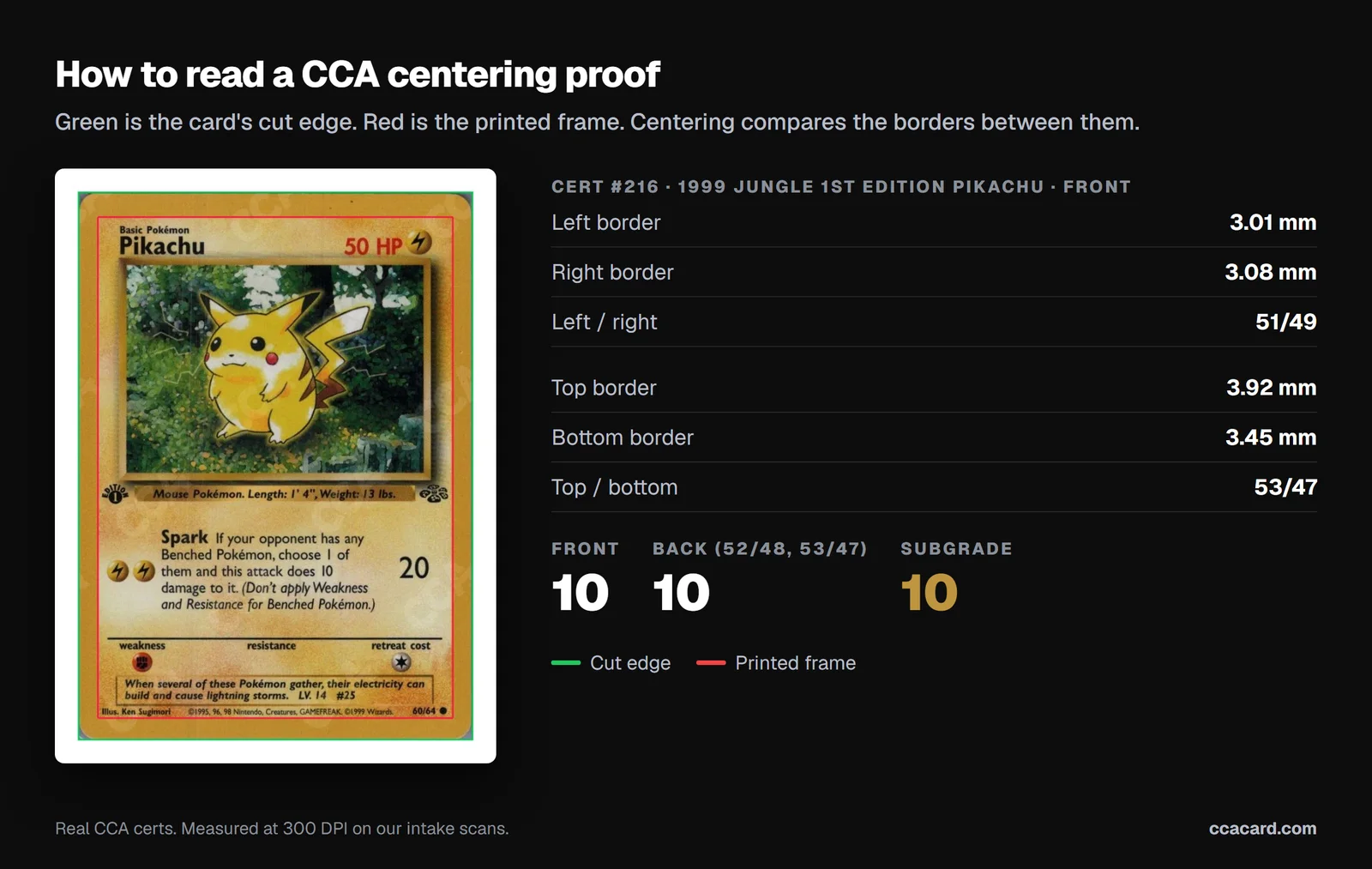
CCA cert pages show this proof once the order is paid: the card cropped at its cut edge, with both outlines drawn on. You can check our measurement yourself rather than take our word for it.
The CCA centering scale
The front and back are graded on separate ladders, with the back one full level easier, because the back is printed separately and matters less to how the card displays. The centering subgrade is the average of the two.
| Centering grade | Front (worse axis) | Back (worse axis) |
|---|---|---|
| 10 | 55/45 or better | 60/40 or better |
| 9.5 | 57/43 or better | - |
| 9 | 60/40 or better | 65/35 or better |
| 8 | 65/35 or better | 70/30 or better |
| 7 | 70/30 or better | 75/25 or better |
The full scale, down to 1, is on our grading standards page along with how centering combines with corners, edges and surface into the overall grade.
What 200+ measured cards showed
| Front centering (worse axis) | Cards | Running total |
|---|---|---|
| 50/50 to 52/48 | 22 | 11% |
| 53/47 to 55/45 | 67 | 44% |
| 56/44 to 57/43 | 43 | 65% |
| 58/42 to 60/40 | 45 | 88% |
| 61/39 to 65/35 | 17 | 96% |
| 66/34 to 70/30 | 6 | 99% |
| Worse than 70/30 | 2 | 100% |
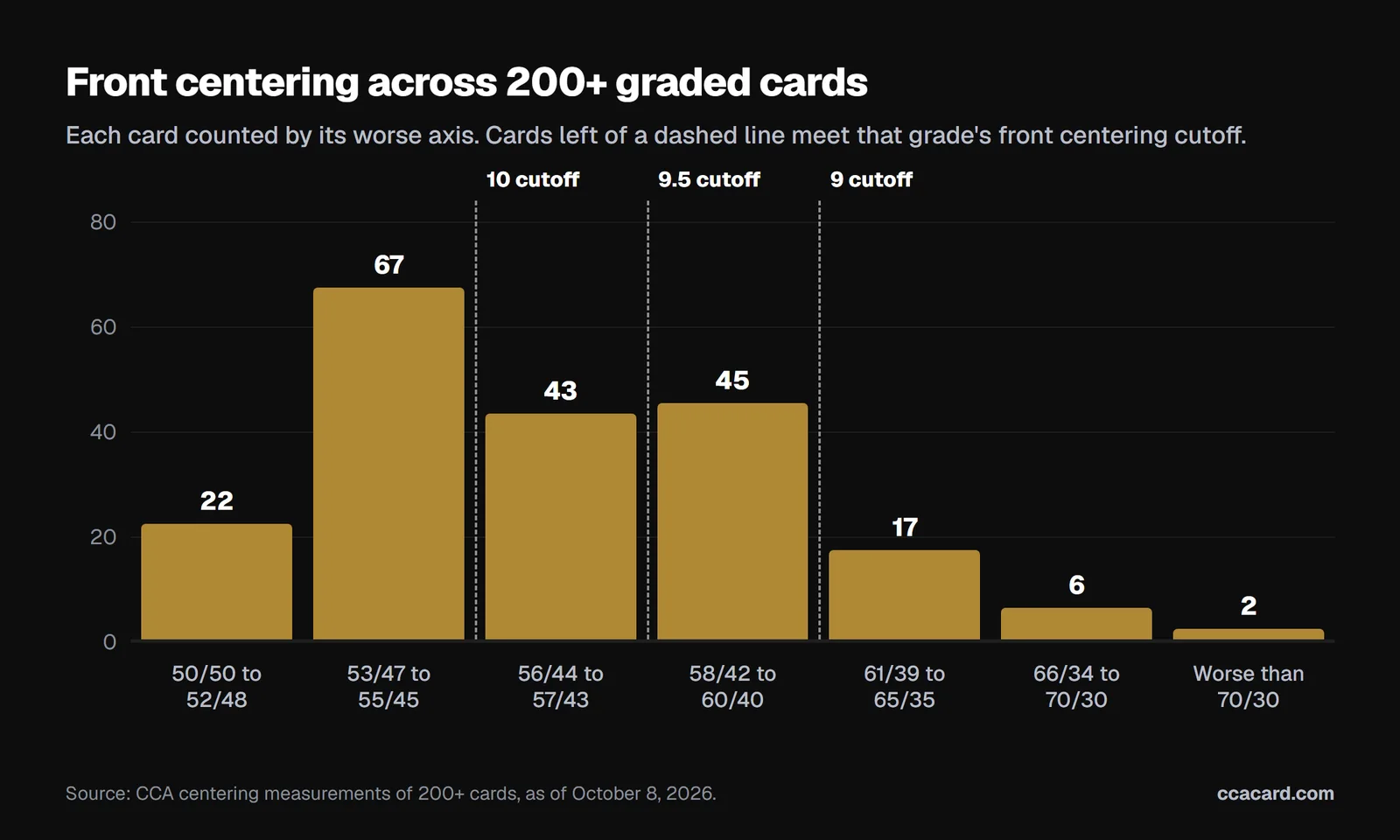
Two things stand out. First, only 22 cards were within 52/48 on their worse axis. True dead center cards are rare, even among cards their owners thought were worth grading. Second, the largest group, 67 cards, landed between 53/47 and 55/45, right at the edge of a 10. For those cards a few hundredths of an inch decided the subgrade.
How few hundredths? Across all of our measured fronts the average left and right borders added up to about 101 pixels at 300 DPI, or 8.6 mm. A 55/45 split on that card means one side is about 0.86 mm wider than the other. Top and bottom borders are thinner (about 6.4 mm combined), so 55/45 there is a difference of about 0.64 mm. That is why we measure from a scan instead of by eye.
Real certs, real measurements
| Cert | Card | Front | Back | Centering | Grade |
|---|---|---|---|---|---|
| #216 | 1999 Pokémon Jungle 1st Edition Pikachu | 51/49 · 53/47 | 52/48 · 53/47 | 10 | 9 |
| #194 | 2026 Panini Prizm FIFA World Cup Cristiano Ronaldo Silver | 59/41 · 57/43 | 61/39 · 62/38 | 9 | 10 |
| #205 | 1990-91 Score Wayne Gretzky | 50/50 · 58/42 | 52/48 · 52/48 | 9.5 | 10 |
| #202 | 2023-24 Panini Prizm Monopoly Victor Wembanyama | 53/47 · 51/49 | 55/45 · 55/45 | 10 | 9 |
| #188 | 1994 Upper Deck Michael Jordan | 50/50 · 59/41 | 57/43 · 55/45 | 9.5 | 9 |
| #191 | 1993 Score Derek Jeter | 53/47 · 59/41 | 53/47 · 53/47 | 9.5 | 9 |
| #186 | 2025-26 Topps Chrome UEFA Lamine Yamal | 56/44 · 53/47 | 51/49 · 53/47 | 10 | 10 |
| #185 | 2024 Topps Superstar Blueprint Shohei Ohtani | 53/47 · 53/47 | 52/48 · 61/39 | 9.5 | 10 |
| #203 | 2023 Panini Select Patrick Mahomes II Silver Die Cut | 56/44 · 53/47 | 54/46 · 51/49 | 10 | 9 |
| #174 | 2026 Pokémon 30th Celebration Palkia Lv.X | 53/47 · 55/45 | 52/48 · 54/46 | 10 | 10 |
| #149 | 2026 Pokémon 30th Celebration Gengar ex | 52/48 · 53/47 | 56/44 · 53/47 | 10 | 10 |
| #190 | 2021 Panini Prizm Draft Picks Josh Allen Red Ice | 55/45 · 56/44 | 51/49 · 56/44 | 10 | 10 |
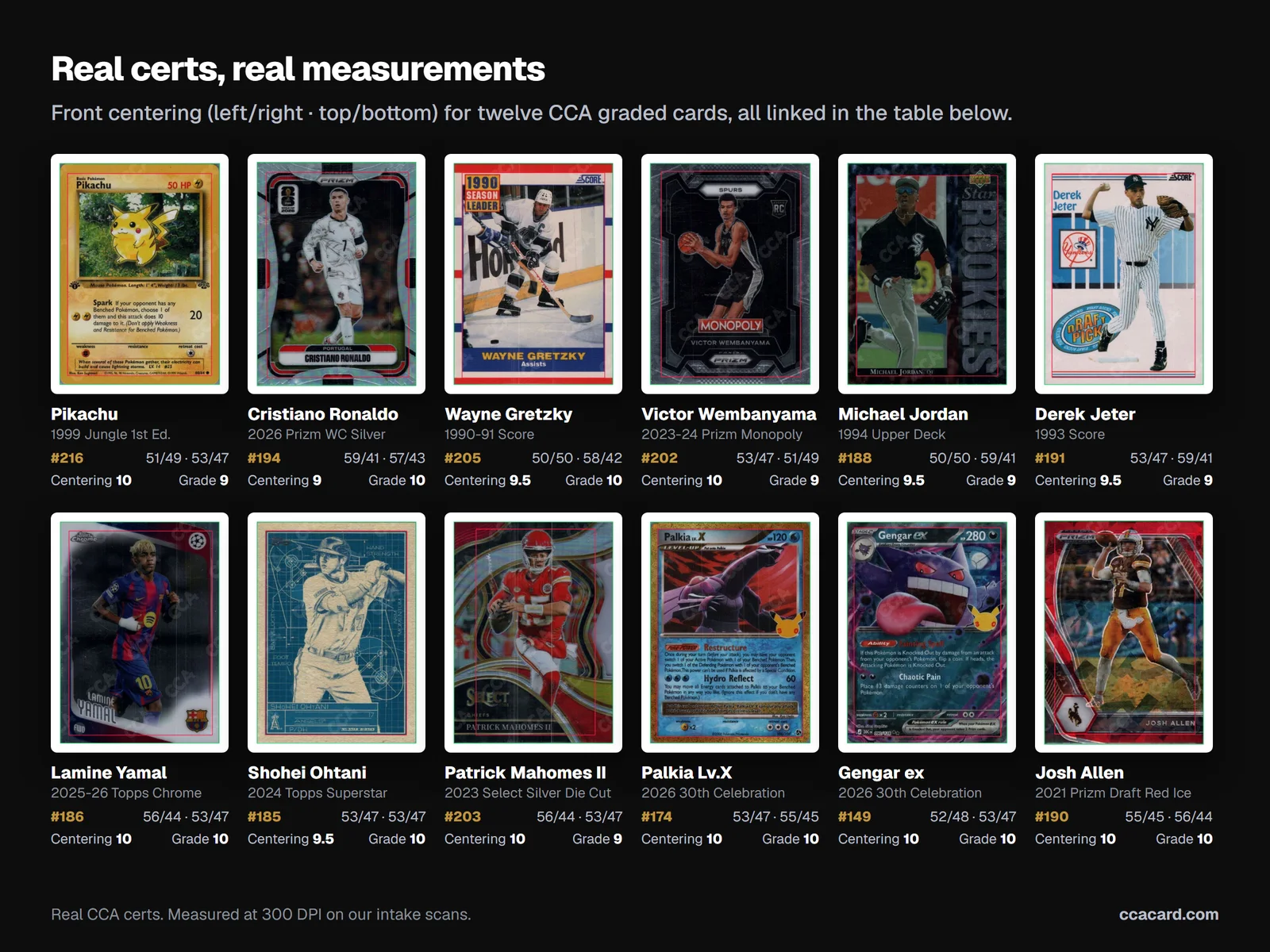
Ratios are left/right · top/bottom. A few patterns are easy to spot here. The 1994 Upper Deck Michael Jordan and the 1990-91 Score Wayne Gretzky are both a perfect 50/50 side to side, and both lost centering points top to bottom. The Cristiano Ronaldo is a Gem Mint 10 overall with a 9 in centering, because centering is one of four subgrades. And several cards with a 56/44 front, like Lamine Yamal and Patrick Mahomes II, still earned a 10 in centering because their backs were nearly perfect.
Off center can go either way
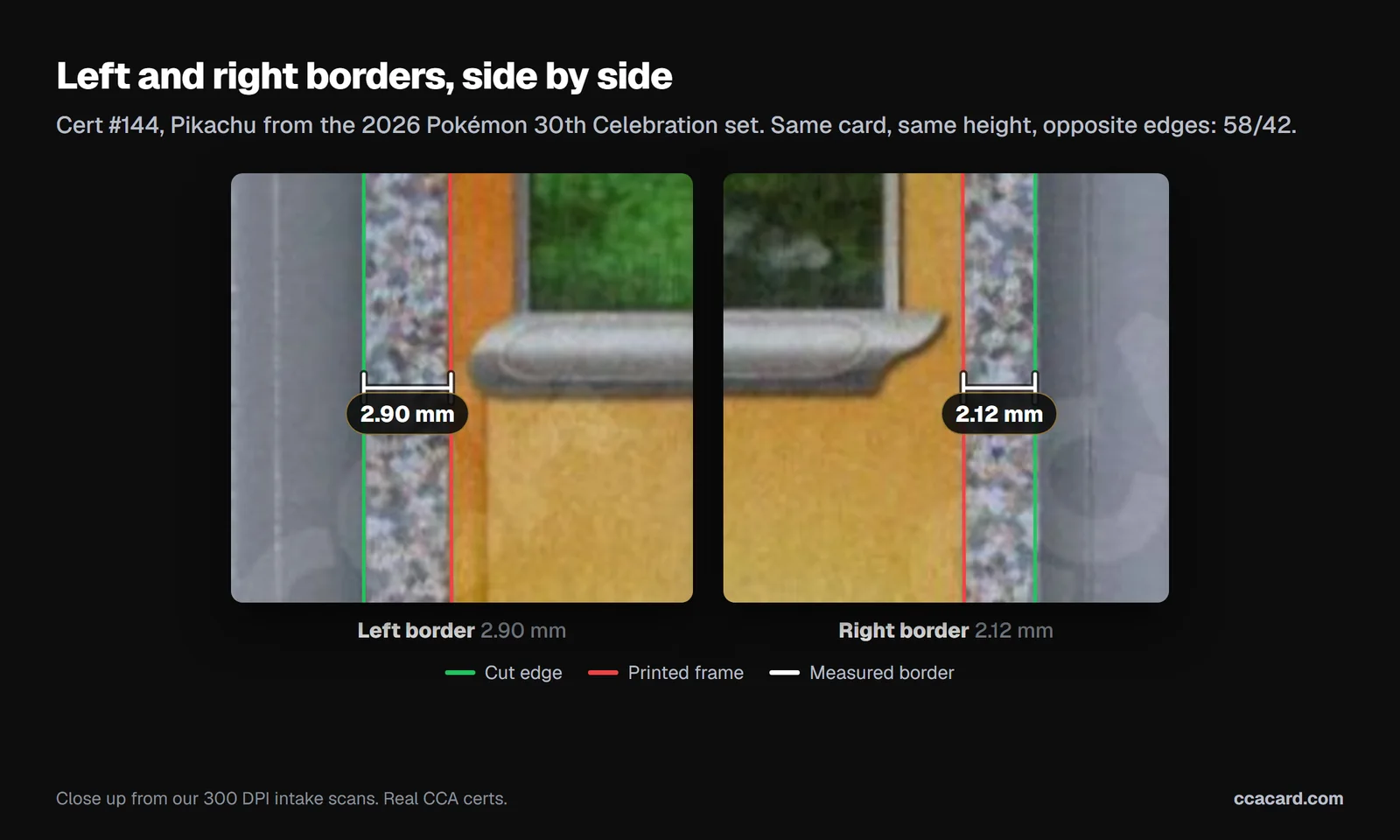
Left to right is the miss most collectors look for first, because it is the one you notice in a binder. It is not the most common one.
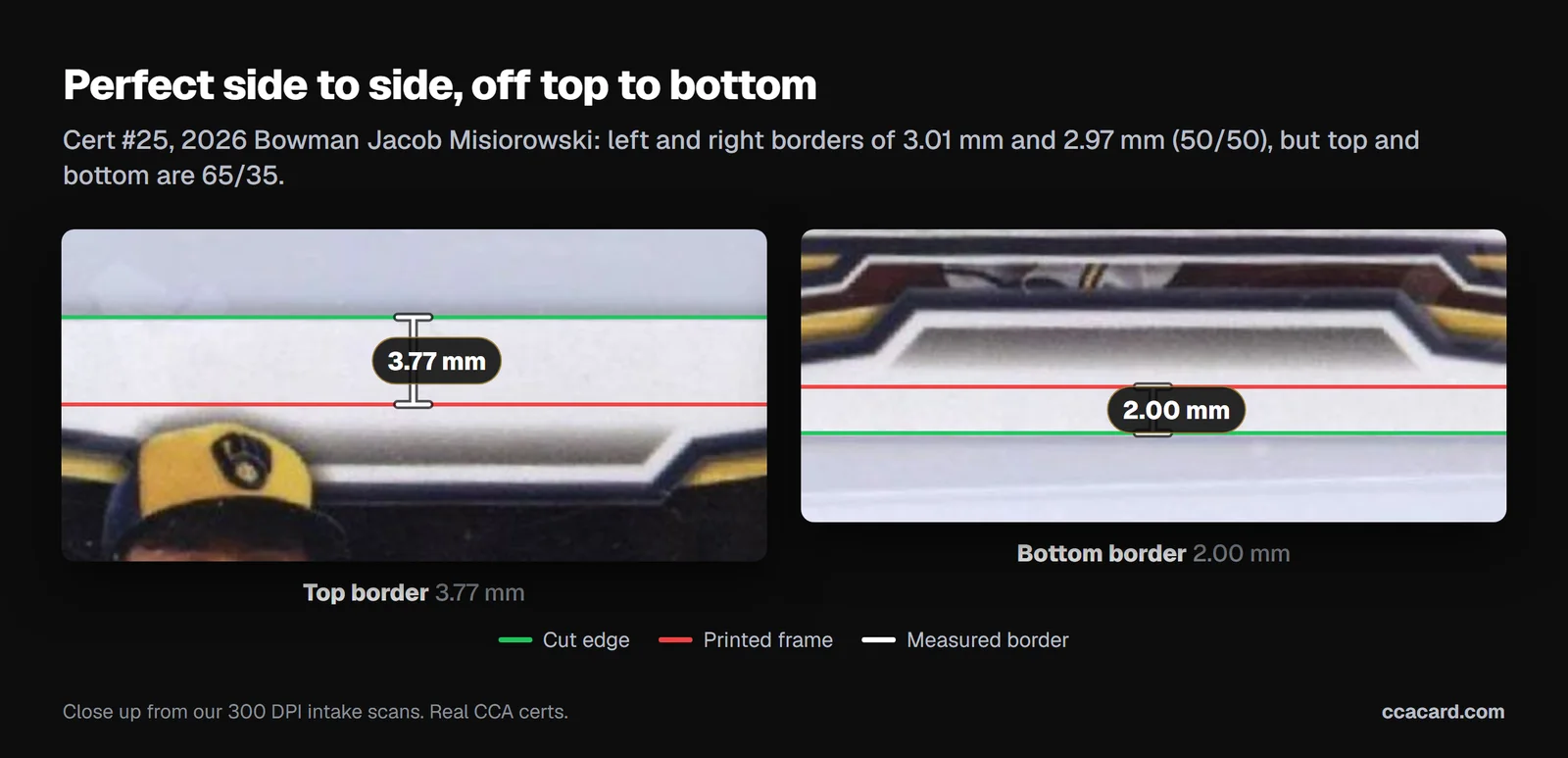
In our data, top/bottom was the worse axis on 109 cards, left/right on 79, and 14 were tied. A card can look perfectly centered at a glance because the side borders match, and still lose a full point on the top and bottom. When you check a card before submitting, check both.
The front and back are printed separately
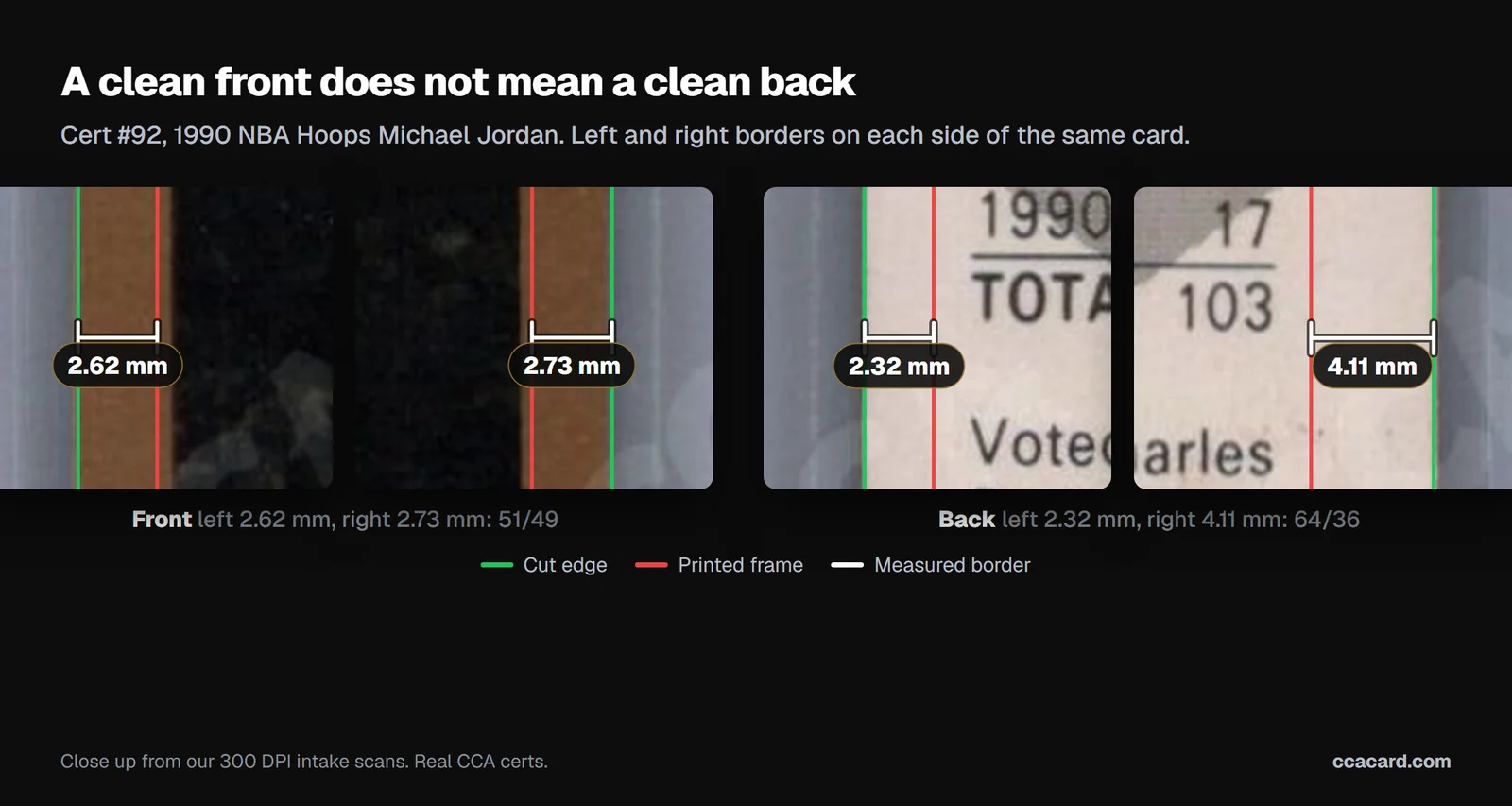
The front and back of a card are printed in separate passes, so their registration does not have to agree. In our data the front was the worse side on 46% of cards and the back on the rest, which is close to a coin flip. A great front does not guarantee a great back, and that is why we scan and measure both on every card.
Because the back ladder is one level easier, a back that looks noticeably off can still score well: 82% of our backs made 60/40, the back cutoff for a 10.
Trading cards vs sports cards, modern vs vintage
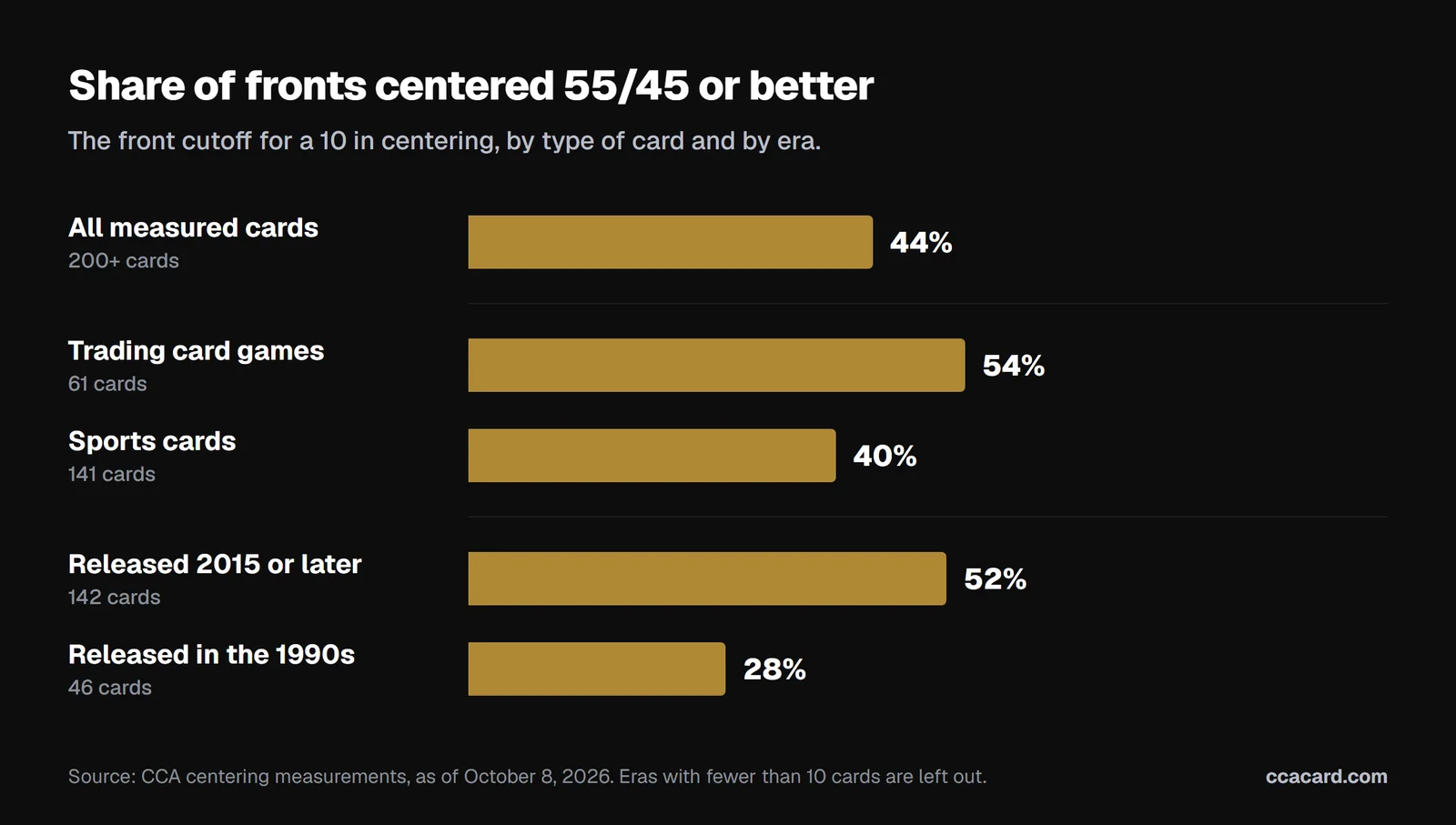
Trading card games (mostly Pokémon in our data) made the 55/45 front cutoff 54% of the time, sports cards 40%. Cards released in 2015 or later made it 52% of the time, cards from the 1990s only 28%. Older printing and cutting simply left more room for drift.
Treat these as early numbers. We have 46 cards from the 1990s and only 14 from before 1990 or from 2000 to 2014, so we have not drawn conclusions about those eras yet. We will update this post as the sample grows.
Three things that look like bad centering
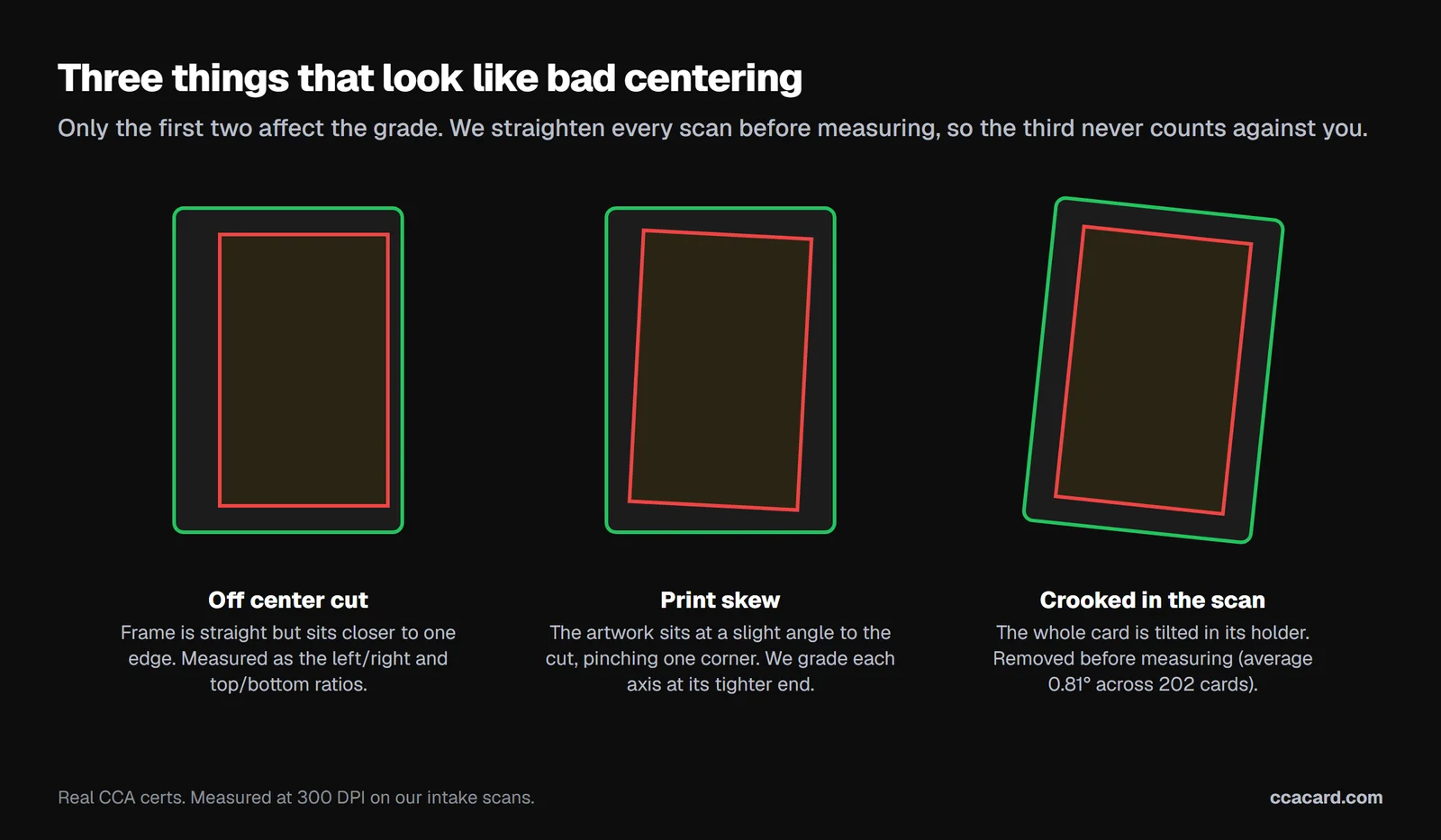
An off center cut is the classic case: the printed frame is straight but sits closer to one edge.
Print skew is when the artwork is printed at a slight angle to the cut, so the borders are not even along a single edge and one corner gets pinched. We measure each axis at both ends and grade it at the tighter end, the same way a grader with a loupe would measure at the worst point. In our data print skew was usually tiny, averaging 0.06°, with 9% of fronts at a quarter of a degree or more. One of the clearest examples is cert #13, a Hydreigon from the Sword & Shield Black Star Promos:
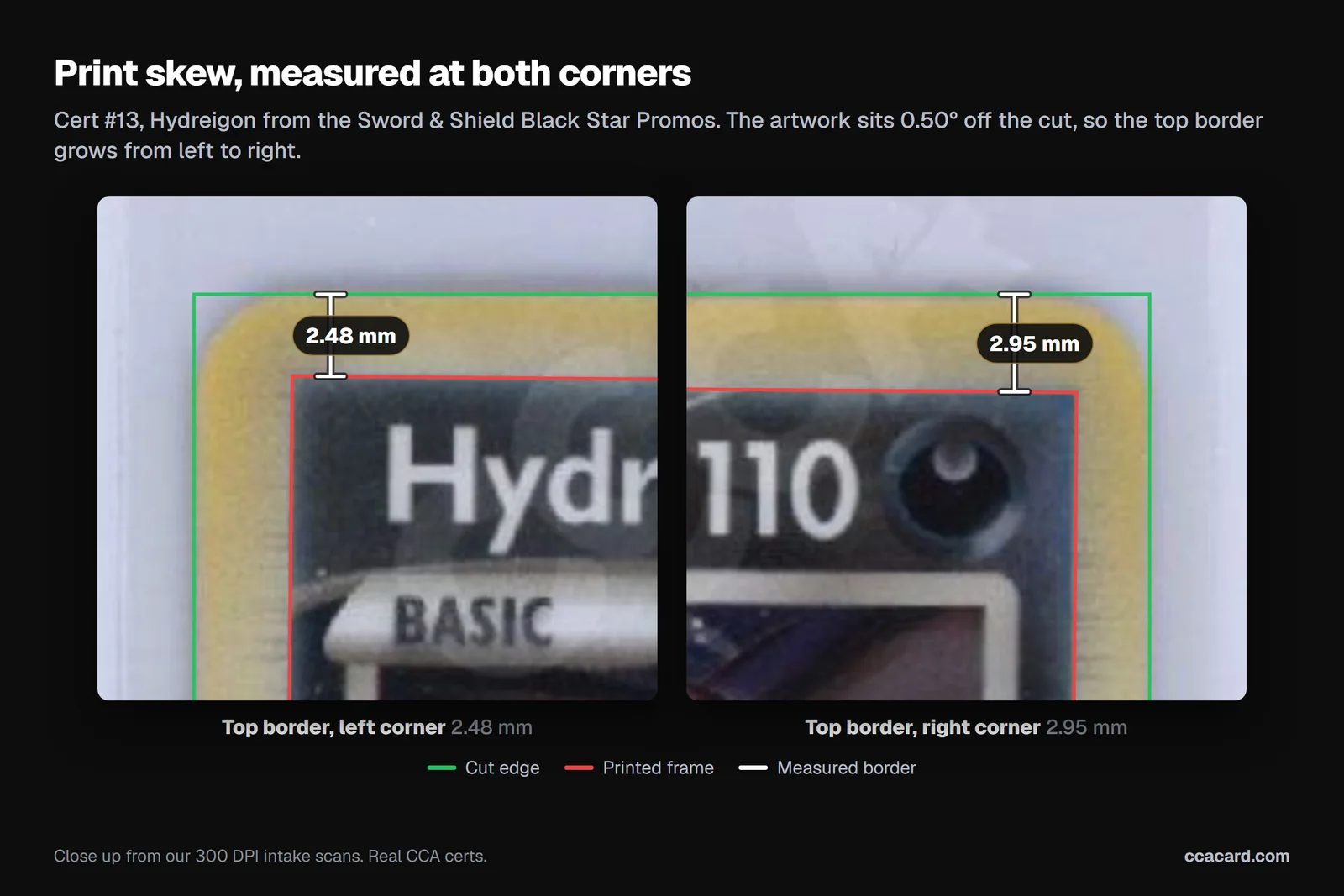
Half a degree sounds like nothing, but on this card it takes almost half a millimeter off the top border from one corner to the other. On a card that is otherwise tight, that alone can cost half a point.
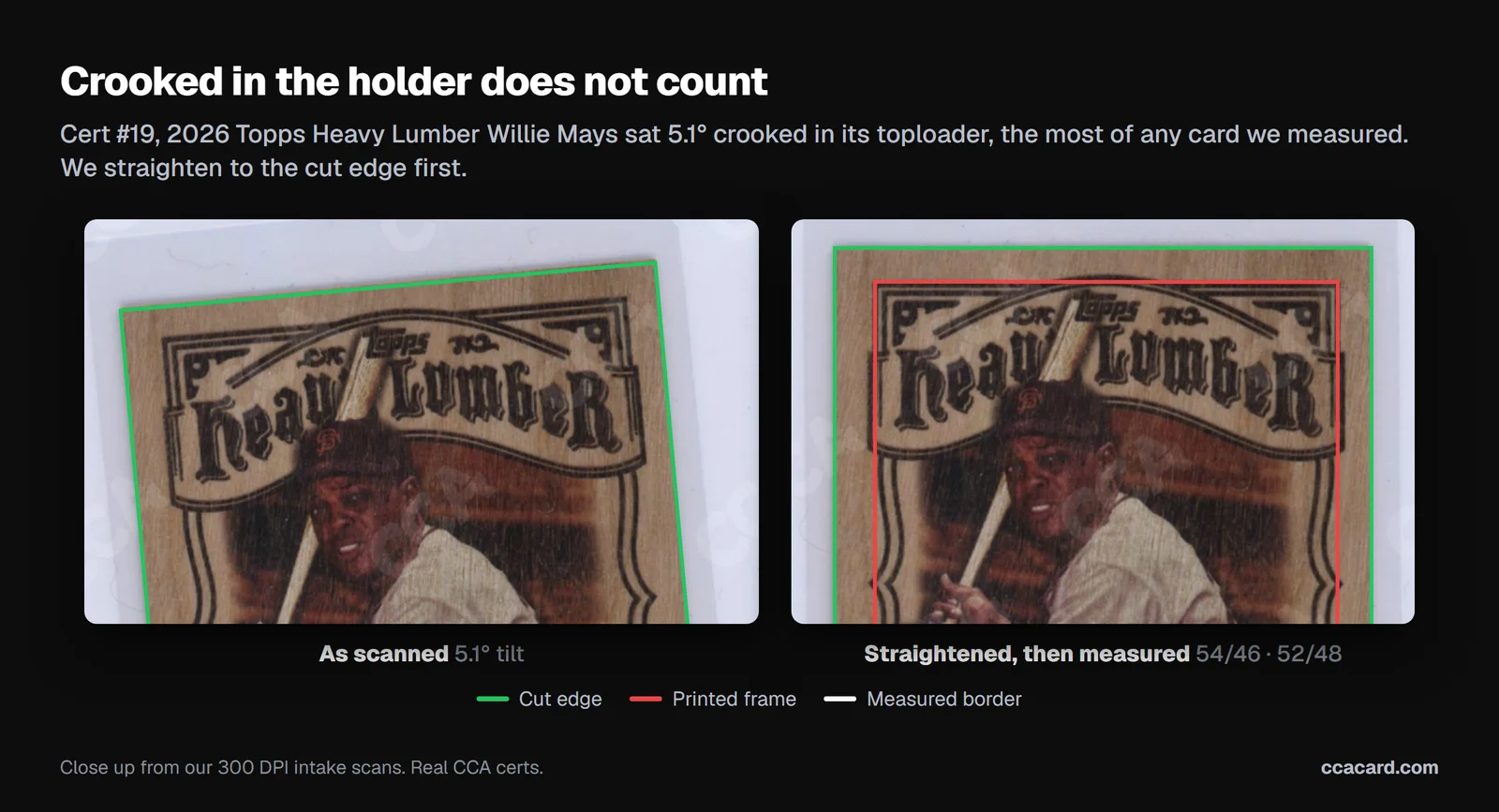
A crooked card in the scan is not a centering problem at all. Cards shift inside a Card Saver or toploader, and our scans showed an average tilt of 0.81°. The system straightens every scan to the card's own cut edges before measuring, so a crooked submission never costs you centering points.
How our system measures centering
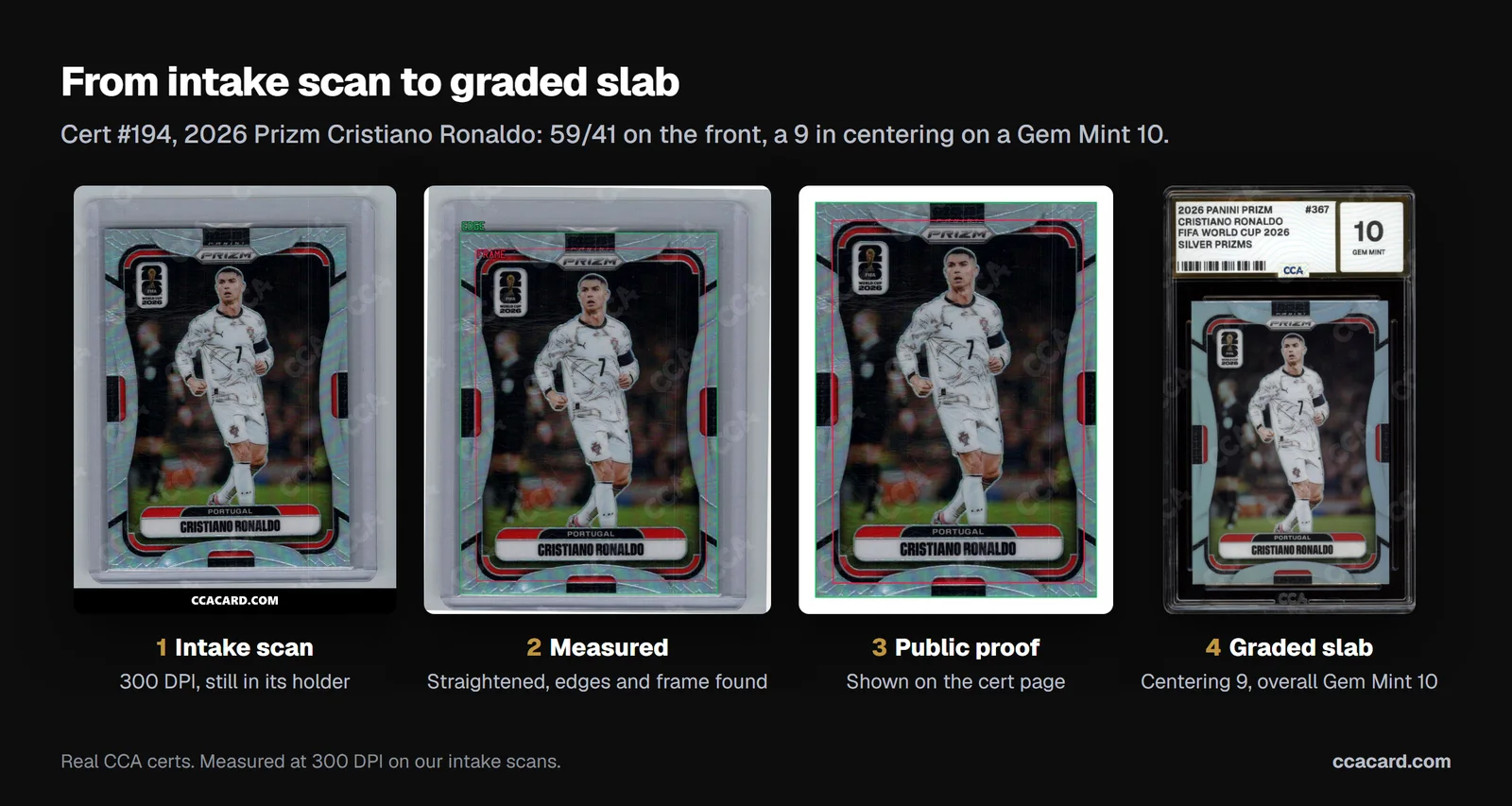
- Scan. Every card is scanned front and back at 300 DPI when it arrives, still in the holder it was sent in. At that resolution one pixel is about 0.085 mm.
- Straighten. The scan is rotated so the card sits square, removing any tilt from the holder or the scanner.
- Find the cut edge. The system looks for the card's four edges using the card's known physical size: 2.5 by 3.5 inches for sports cards and 63 by 88 mm for trading card games. Knowing the size lets it reject the edges of the holder, which is the most common thing to mistake for the card.
- Find the printed frame and measure each border, at both ends of every edge so print skew is caught.
- Grade it on the scale above, then hand it to a grader.
- Grader review. A grader checks every line in our Center Grading Tool and adjusts anything that is off before the subgrade is saved. The official centering subgrade matched the saved measurement on all but three cards; on those three the grader overrode it.
- Publish the proof on the cert page, so the measurement behind the grade is public.
The measurement itself is plain geometry. There is no AI model deciding your grade, and the same scan always produces the same numbers. It takes a few seconds per card. Where an AI model does help is placing the lines on designs that are genuinely hard to read, like full art cards whose border is part of the artwork. Even then it only suggests the lines; the grader confirms them and the math does the grading.
Full art and borderless cards
Full art Pokémon, Prizm parallels and other busy designs do not have a plain border, so "where is the frame?" becomes a judgment call. We use the printed design line that runs parallel to the cut on all four sides. Here is what that looks like up close:
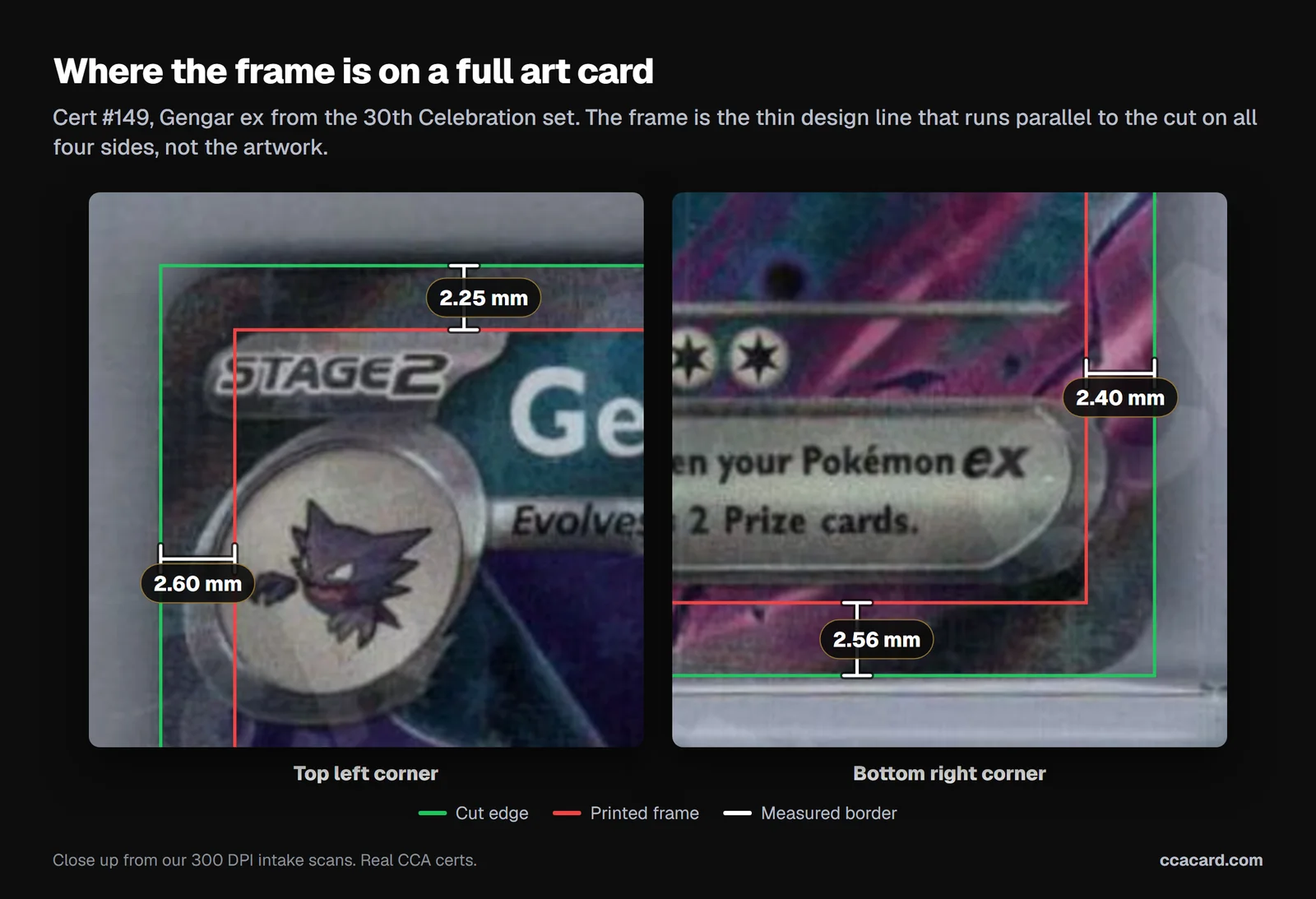
Using the same line on every card of the same design keeps the results comparable, which leads to the next point.
How it gets better as we grade
The system does not retrain itself, and we would not want it to. It improves because every card a grader approves becomes reference data for future cards and test data for any change we make:
- It remembers each set's design. Cards from the same set share one printed layout. When a grader corrects the frame on one card, that correction is saved as a reference, and the next card from that set starts with its frame placed from the cards we have already graded. So far 26 sets have two or more measured cards (90 cards in total), and every new card adds to it. This also makes review faster, because the grader starts from a position that has already been checked on that design.
- Every graded card becomes a test case. When we change the measurement code, we check it by running it against the grader approved cards again and comparing the results. That test set now covers 364 sides and grows with every submission.
- Calibration comes from real cards. For example, the system links a card's front and back measurements using an offset calibrated on more than 100 grader approved front and back pairs.
Here is where things honestly stand. When we ran the automatic detector by itself against our graders' final lines, it found the card's outline on its own on 97% of sides (353 of 364). Its centering ratio landed within 5 points of the grader's final measurement on 59% of sides. The misses are usually cards where the holder or a full art design confuses the edge search. That is why a grader reviews every card today, and why each correction matters: it becomes the reference and the test case for the next card like it.
How to check centering before you submit
- Measure both axes. Top to bottom is off more often than you would expect.
- Check the back too. It is graded on an easier ladder, but a badly off back will still pull the centering subgrade down.
- Use the 55/45 rule of thumb. On a standard card, if one side border is visibly about a millimeter wider than the other, the card is probably past 55/45 and unlikely to get a 10 in centering.
- Do not worry about a crooked holder. We straighten every scan before measuring.
- Remember centering is one of four subgrades. Corners, edges and surface count too; see our grading standards.
How we put these numbers together
Data covers every card with a completed centering analysis as of October 8, 2026: 200+ cards and 400+ sides, all measured on 300 DPI intake scans and reviewed by a CCA grader. These are customer submissions, not a random sample of all cards printed, so they lean toward cards people expected to grade well. Percentages use each card's worse axis. Millimeter figures convert pixels at 300 DPI. Groups with fewer than 10 cards are not charted. Examples link to their public certificates, where you can see each proof.
Frequently asked questions
What centering do you need for a 10 at CCA?
55/45 or better on the front and 60/40 or better on the back, measured on the worse axis of each side. The centering subgrade is the average of the front and back scores.
Does back centering matter?
Yes. The back is graded one level easier than the front, but it still counts toward the centering subgrade. On cert #92, a 1990 NBA Hoops Michael Jordan, a 51/49 front and a 64/36 back averaged to a 9.
Will a card that shifted in its toploader lose centering points?
No. We straighten every scan to the card's own edges before measuring, so the angle a card sits at in its holder does not affect its centering grade.
What is print skew?
Print skew is when the artwork is printed at a slight angle to the card's cut, so one corner's border is thinner than the others. We grade each axis at its tightest point, so heavy print skew lowers centering. In our data it is usually well under a quarter of a degree.
Can I see how my card's centering was measured?
Yes. Once your order is paid, your card's public certificate page shows the front and back centering proofs with the measured ratios.
Grade your cards with CCA
Every card we grade gets the same measurement, a grader's review, and a public proof on its certificate. Grading starts from $8/card for bulk (10 card minimum), $10 standard. See pricing or start a submission.