
One Label Formula for Every Pokémon Set, Promo and Language: The New CCA Slab Label Standard
How CCA slab labels are now built: series and language codes like SV EN and ME EN, set names that fit, promos that name their product, and the pull rate words we leave off. With then and now examples from real slabs.
Shane Elmer
Author
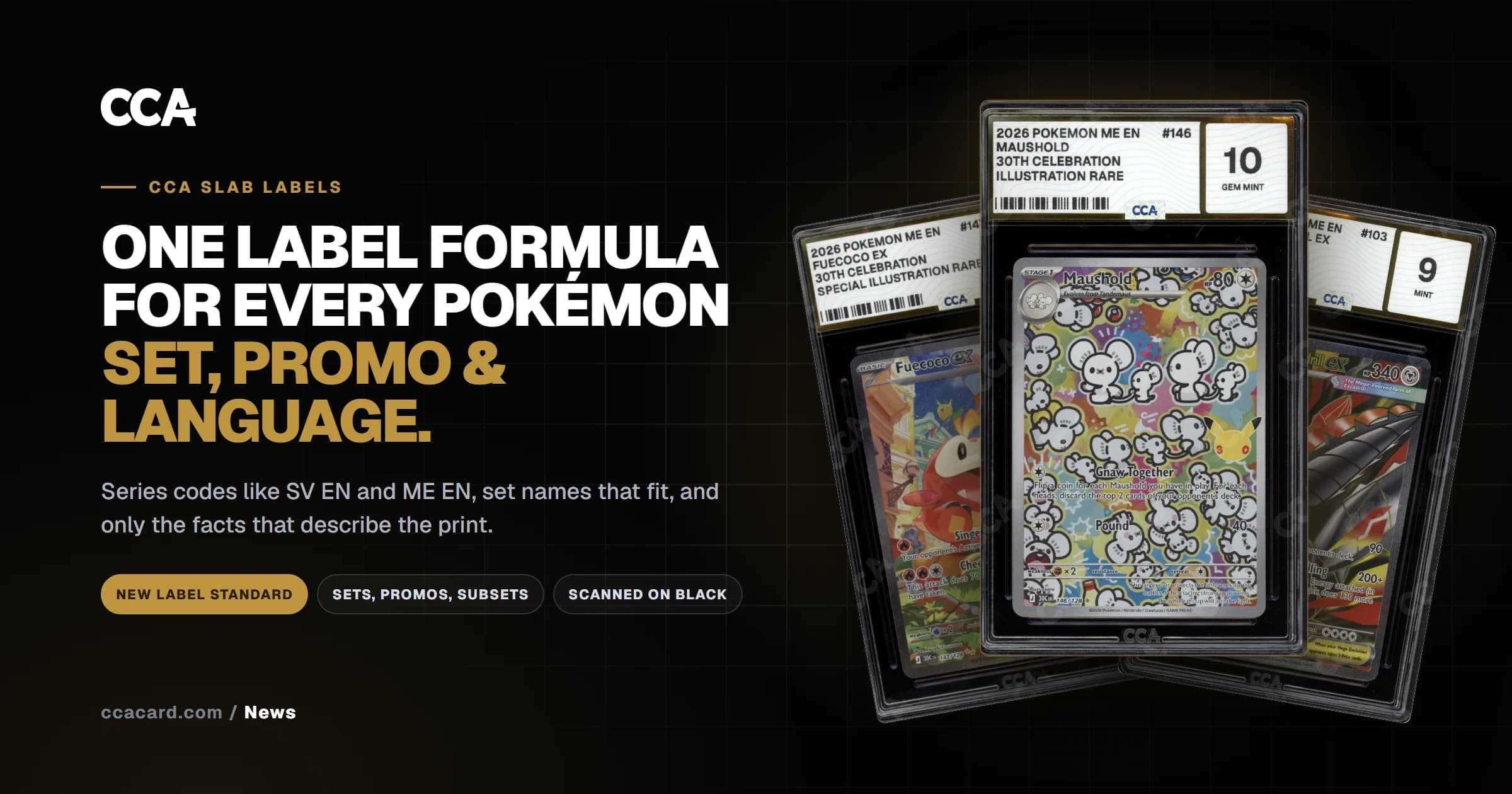
A slab label has one job: tell you exactly which card is inside, in the two seconds it takes to glance at it. That sounds simple until you try to do it for Pokémon. There are well over a hundred English sets, more than a dozen languages of print, promo cards that live inside tins and collection boxes rather than booster packs, stamped versions of regular cards, and subsets with their own numbering and their own rarity. A label has four short lines to cover all of it.
Over the past few weeks we rebuilt how CCA labels are put together. The result is a single formula that produces the same kind of label for a Metal Card from the 151 Ultra-Premium Collection, a stamped promo from the 30th Celebration set and an Ultra Rare from Pitch Black, and that will keep working when we add Japanese and other language prints. This post explains what changed, why, and how to read a CCA label.
At a glance
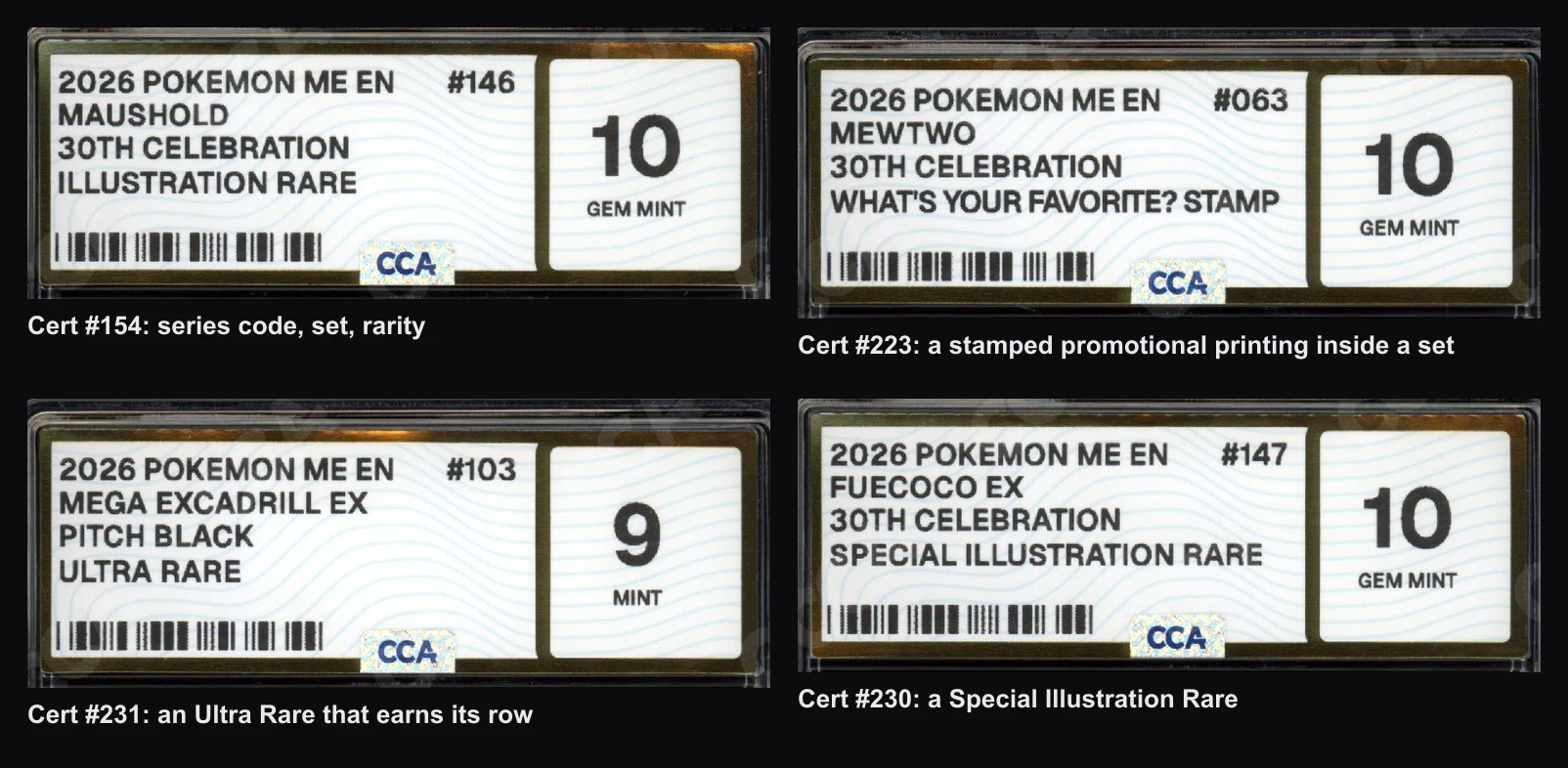
- Every label reads the same way: year, game and series code on line one with the card number at its right, the card name on line two, the set on line three, and one line for the fact that describes the print, when there is one.
- Line one carries the era and the language as a code: the series for a set card (SV EN is Scarlet & Violet in English, ME EN is Mega Evolution in English), or the promo set for a Black Star Promo (SVP EN).
- Promos name the product they came from, not just the promo checklist they were numbered into.
- Basic rarity designations are left off. Common, Uncommon, a bare Rare, a bare Holo and the word Promo never print. A rarity prints only when it identifies the card's category: Illustration Rare, Ultra Rare, Reverse Holo and the like.
- Every slab is now scanned on a black background so the card, the holder and the label all read clearly, which you can see throughout this post.
What the early labels got right, and where they ran out of road
Our first labels were written the way a collector describes a card out loud: "1999 Pokémon, Alakazam, Base Set Unlimited, Rare." That reads well, and for a vintage card it is complete. The trouble started as soon as the cards did not come from a numbered booster set.
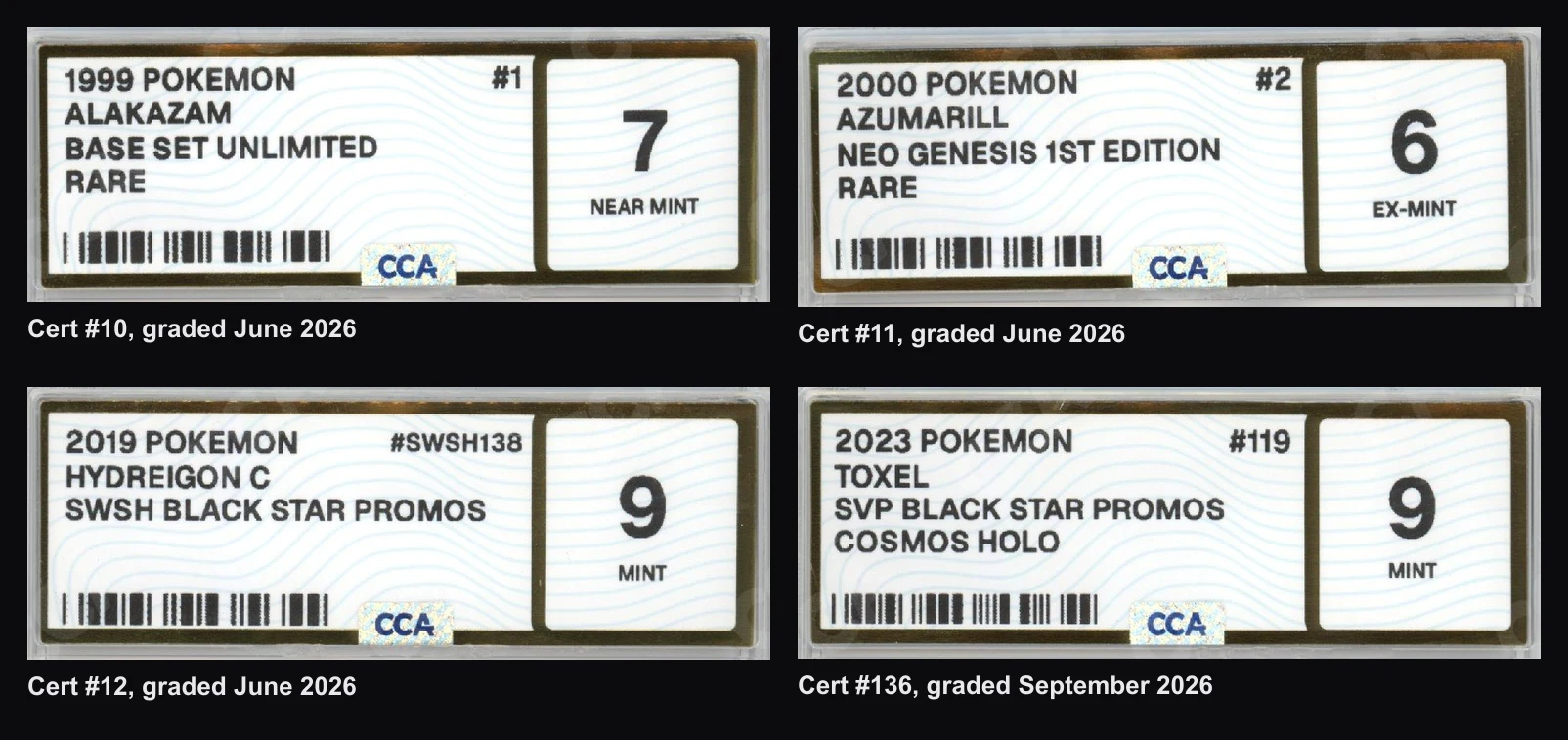
Look at the two promo labels. "SWSH Black Star Promos" and "SVP Black Star Promos" tell you the promo checklist the card was numbered into, but not which product it actually came out of: the Hydreigon C came in the Celebrations Collector Chest, and the Toxel's "Cosmos Holo" line tells you the foil pattern but not that it came in a Twilight Masquerade single pack blister. Both years are wrong as well. The Hydreigon C label says 2019 and the Toxel label says 2023, which are the years those promo checklists began, not the years the cards were released (October 2021 and 2024). Those two records have since been corrected in our catalog, and the slabs will be relabeled; we leave the old labels in this picture because they show exactly the kind of mistake a formula is meant to prevent. A collector who knows the hobby can fill in the gaps. A label should not need that.
There was a second problem you cannot see on any single label: no two of them followed the same rule for what the third line meant. Sometimes it was the set and the print together ("Base Set Unlimited"), sometimes the promo series, sometimes a subset. That was fine with a few dozen slabs. It would never have held up across every Pokémon set, let alone across a dozen languages where "Base Set" is a different product in each one.
The formula
Every CCA label now has the same four lines, and each line has one meaning.
| Line | What it holds | Example (cert #231) |
|---|---|---|
| 1 | Year, game, era code and language code, with the card number on the right | 2026 POKEMON ME EN #103 |
| 2 | Card name | MEGA EXCADRILL EX |
| 3 | Set, or the product the card came from | PITCH BLACK |
| 4 | One identifying designation, only when the card has one: a verified error, otherwise a rarity we print, otherwise the print variant | ULTRA RARE |
The order never changes and nothing is ever repeated. If the card has no designation worth stating, the fourth line is simply not there, and the label is three lines. Line four is a reserved slot, not a free text field: it holds a verified error designation when the card has one (a miscut, a crimp, a missing foil layer, whatever we have documented on the cert page), otherwise the rarity, otherwise the print variant, and never more than one of them. That reservation is which is what keeps labels from two different graders, or two different years, looking alike.
The year on line one is the year the card was released, not the year it was graded and not the copyright year printed on the card. For a card from an expansion that is the set's release year: a 30th Celebration card prints 2026 because the set released in 2026, and every card in the set prints the same year. For a promo it is the year that promo was actually released, which is often not the year its checklist began. The Sword & Shield promo checklist started in 2019, but Hydreigon C SWSH138 was released in October 2021 in the Celebrations Collector Chest, so its label prints 2021. Our catalog records a release year on the card itself whenever it differs from the set, and the label reads that first.
Line one: the era and the language, as a code
Pokémon organizes its sets into series: Base Set, Neo, EX, Diamond & Pearl, XY, Sun & Moon, Sword & Shield, Scarlet & Violet, Mega Evolution. The series is the single most useful thing to know about a modern card, because it tells you the era, the card frame, the rarity scheme and roughly the value range before you have even read the set name. Full series names do not fit on a label next to the year and the game, so the label uses a short code.
| Code | Series | Language |
|---|---|---|
| SV EN | Scarlet & Violet | English |
| SWSH EN | Sword & Shield | English |
| ME EN | Mega Evolution | English |
| SVP EN | Scarlet & Violet Black Star Promos (a promo set code, used in place of the series code) | English |
One rule decides which code goes on line one. A card from an expansion carries its series: SV EN, SWSH EN, ME EN. A card from a Black Star Promo checklist carries the promo set instead: SVP EN for the Scarlet & Violet promos, and the same pattern for every era's promos. The promo checklist is that card's set, it tells you from line one that the card is a promo, and it frees line three for the product the card came in. The two codes never appear together.
The language code is deliberately part of the slot. A Japanese Scarlet & Violet card is a different print run from the English one, with its own set list, numbering and population, and when we grade one its label will carry the same series code with its own language code in the same place. English carries EN today for the same reason: the label should say what it is, not leave it to be assumed.
Line three: the set, named the way a label needs it
Our catalog stores the official name of every set, and the label usually prints it as is. A set gets a separate label name only when the official name misleads on a label or wastes space saying something line one already said. Three examples from recent slabs:
- Black Star Promo checklists move to line one. SVP Black Star Promos prints as the code SVP EN in the era slot, and the promo's set line is spent on the product it came from (next section).
- 30th Celebration: Classic Collection prints as 30th Classic Collection. Same subset, shorter, and it no longer reads as if the card is from the main 30th Celebration set.
These label names change nothing in the catalog or on the cert page. The full official set name is always on the cert record; the label name exists only so that the four lines read cleanly.
Promos: the product, not just the checklist
Modern Pokémon promos are numbered into a running checklist (SVP 052, SVP 205 and so on) but they are sold inside a specific product, and the product is what collectors search for. The Mewtwo promo from the 151 Ultra-Premium Collection reads 2023 POKEMON SVP EN / MEWTWO / 151 ULTRA-PREMIUM COLLECTION. The promo checklist is the code on line one, the product is on the set line, and the Metal Card version of the Mew ex from the same box earns a fourth line that says METAL CARD, because that is the fact that separates it from the regular promo. (Our first 151 Ultra-Premium slabs were printed before this rule was settled and carry the series code instead; they are being relabeled, which is the point of having a formula.)
Cert #242 is the other case: a card that belongs to an expansion but was printed for a product. The Darkrai is a Darkness Ablaze card, number 105, and its Cosmos Holo print only came in the Mighty Mysterious Tin. Its label prints SWSH EN on line one, MIGHTY MYSTERIOUS TIN on the set line and COSMOS HOLO on the print line. That is a deliberate exception to "line three is the set": the underlying expansion is still Darkness Ablaze, and that is how the card is filed and numbered on the cert page, but the tin is what identifies this particular printing, so the product name takes the set line and the expansion stays in the record behind it.
Stamps, promotional printings and subsets
Some cards are promotional printings of a regular set card that keep the set's own numbering. Cert #223 is a 30th Celebration Mewtwo, number 063/128, with the "What's Your Favorite?" promotional stamp, given away at participating retailers with a qualifying purchase rather than pulled from a pack. Its label says 30TH CELEBRATION on the set line and WHAT'S YOUR FAVORITE? STAMP on the print line, because the stamp is what identifies this exact version. The regular Mewtwo from the same set prints without that line. The stamp wording is what goes on the label; whether a card is a promotional release is a separate fact about how it was distributed, and it is recorded on the cert page rather than spelled out on the slab.
Not every stamped card is a promotional release, and not every promotional release is stamped. A card's promotional status comes from how it was officially released and distributed, not from the presence of a stamp, so the label describes the print you can see and leaves the classification to the record behind it.
Named subsets are different again. Shiny Vault in Shining Fates is a separately numbered subset inside the expansion, pulled from the same booster packs as the main set, with its own card numbers and its own rarities. It is not a promotional release and it is not a rarity. On the label, the subset name prints on the fourth line, because it is the fact that places the card: a Shiny Vault Alcremie and a main set Alcremie are different cards with different numbers, and the subset is what tells them apart at a glance. The card's own rarity within the subset belongs on the cert page.
What we leave off, and why
This is the part of the standard that took the most thought. Common, Uncommon and Rare are the basic rarity designations every set uses, and on their own they do not identify a card's category: a Rare from one set and a Rare from another are not the same kind of print, and a bare "Holo" or "Rare" on a label raises more questions than it answers (Holo Rare? Reverse Holo? a holo promo?). We print a rarity only when it meaningfully identifies what the card is. So the label never prints:
- Common, Uncommon, or a bare Rare
- a bare Holo (the specific holo tier prints instead)
- Promo (the set line already names the product, and line one already names the promo series)
- Normal (the plain, unfoiled print is the default and needs no label)
What does print is anything that names a specific, recognizable print: Holo Rare and Non-Holo Rare, Reverse Holo, Double Rare, Ultra Rare, Illustration Rare, Special Illustration Rare, Hyper Rare, Secret Rare, Shiny Vault, ACE SPEC, Radiant Rare, Amazing Rare, Cosmos Holo, Metal Card and stamps. A Pikachu from a booster pack, cert #225, prints as three clean lines. A Mega Excadrill ex Ultra Rare, cert #231, prints four.
Everything we leave off the label is still on the cert page. The label is a summary, the cert record at ccacard.com/cert is the full description, and the two will never disagree because they are generated from the same catalog entry.
One fact, once
A few rules run behind every label to keep it honest and readable:
- Nothing prints twice. If the series code already says Mega Evolution, the set line will not say it again. If a product name and a variant name happen to be the same text, it prints once.
- The fourth line has a fixed order. When several facts compete for it, the label does not judge which is "most specific"; it follows one rule. A documented error title prints first. Otherwise the rarity prints, when it is one we print (Illustration Rare, Ultra Rare, Shiny Vault and so on). Otherwise the variant prints: a foil pattern such as Cosmos Holo, a stamp, a Metal Card. So a stamped Illustration Rare prints ILLUSTRATION RARE, a Cosmos Holo promotional variant prints COSMOS HOLO, and the fact that did not make the label is on the cert page. The same card always gets the same line.
- Every line the same size. A long set name used to shrink to fit and sit visibly smaller than its neighbors. Now the text first tightens its letter spacing by a hair, which the eye does not notice, and only shrinks when it truly has to. A line like 151 ULTRA-PREMIUM COLLECTION sits at the same height as the lines around it.
Then and now on the same card
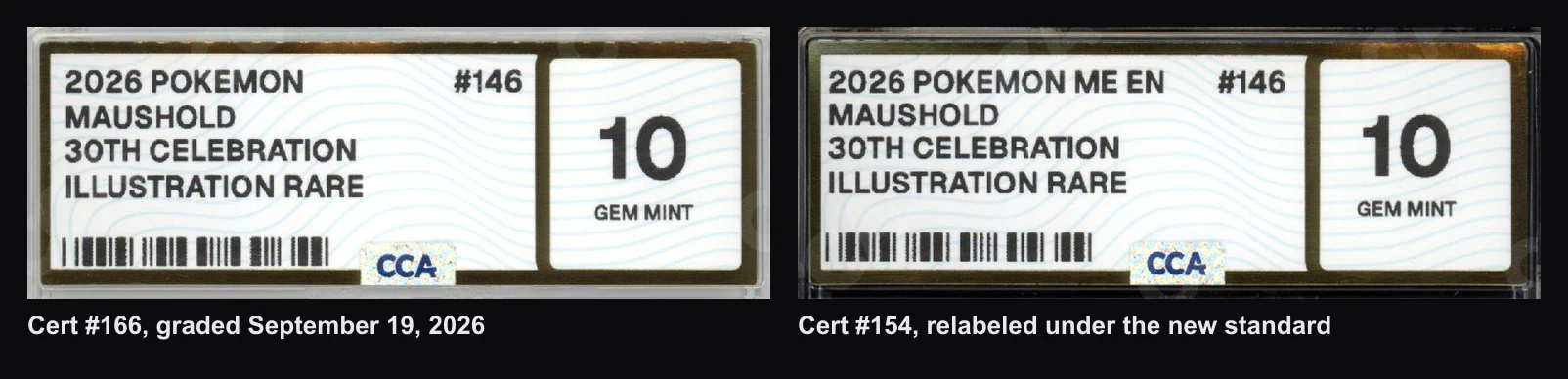
Two copies of the same card show the whole change in one line. The original label reads 2026 POKEMON / MAUSHOLD / 30TH CELEBRATION / ILLUSTRATION RARE. The relabeled slab reads 2026 POKEMON ME EN / MAUSHOLD / 30TH CELEBRATION / ILLUSTRATION RARE. One code, and now you know the era and the language without looking anything up, and the label is built the same way as every other slab we have graded since. Cert #154 is also the slab we used in the comparison above, so you can see the same label next to the other four services.
Slabs graded under the earlier labels are not being recalled or relabeled. Those labels are accurate descriptions of their cards, and their cert pages carry the full record either way. The standard applies to everything graded from here on, and the codes are being extended era by era as we file older sets into the catalog.
How this compares with the other labels on the market
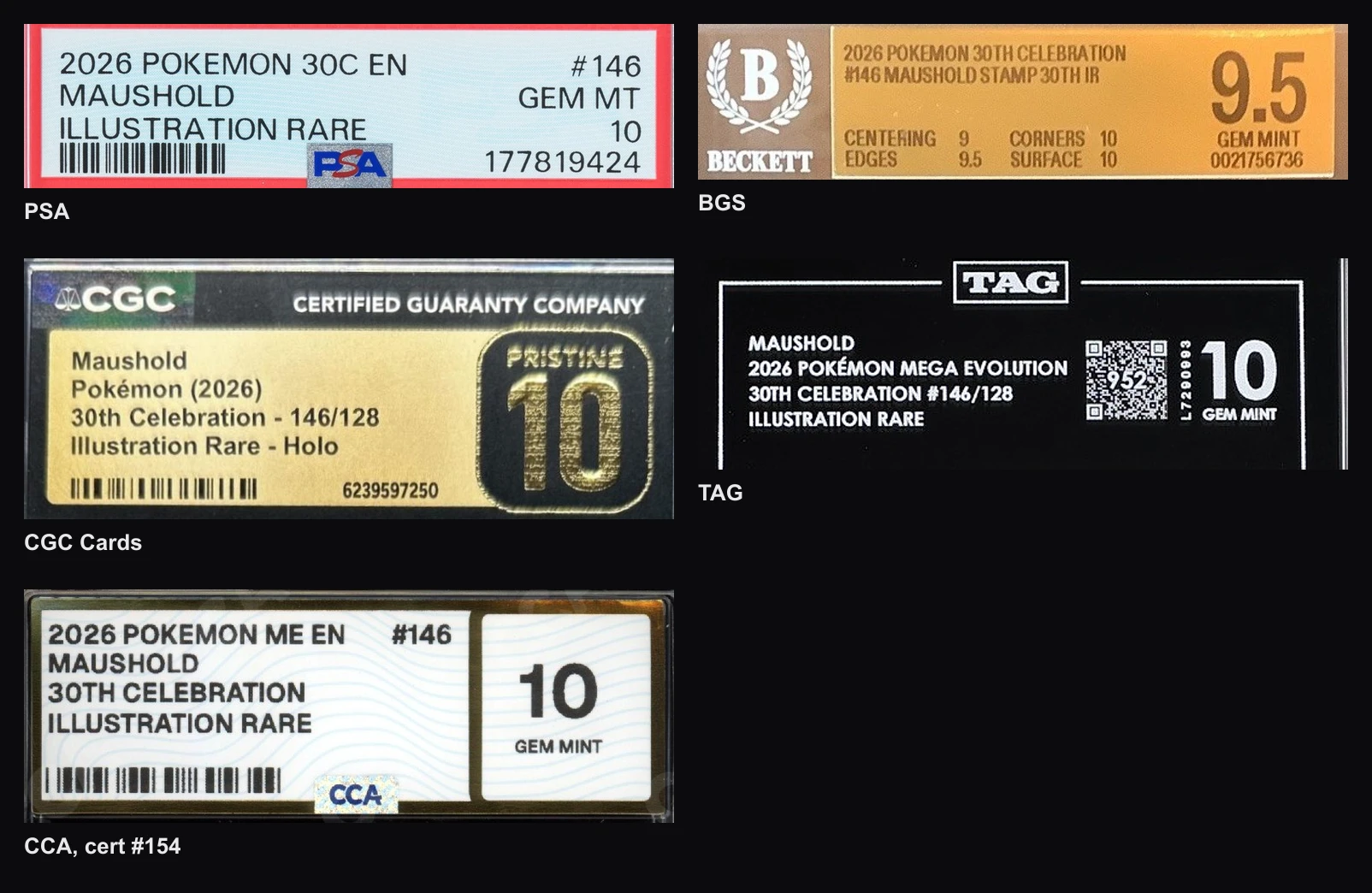
It would be easy to write this post as if our label were the only one that makes sense. It is not. Every established grader has thought about the same problem, and a fair comparison helps you decide what you want on a slab. So we took one card that all five services have graded, the 30th Celebration Maushold Illustration Rare, number 146/128, and photographed how each one prints it. The crops below are the labels themselves, and the table under them repeats each one line for line. Ours is cert #154.
| Service | As printed on the label | What stands out |
|---|---|---|
| PSA | 2026 POKEMON 30C EN #146 MAUSHOLD ILLUSTRATION RARE | Three lines, number top right. A set code plus language on line one, so the set is never written out. Rarity on line three. |
| BGS | 2026 POKEMON 30TH CELEBRATION #146 MAUSHOLD STAMP 30TH IR | Two lines for the card, then the four subgrades underneath (not shown here). The stamp and the rarity are squeezed in after the name as "STAMP 30TH IR". |
| CGC Cards | Maushold Pokémon (2026) 30th Celebration - 146/128 Illustration Rare - Holo | Mixed case and full names, the easiest to read of the five. Names no series. Adds "Holo" to the rarity, which every Illustration Rare is. |
| TAG | MAUSHOLD 2026 POKÉMON MEGA EVOLUTION 30TH CELEBRATION #146/128 ILLUSTRATION RARE | Spells out the series in full. Card name first, then year and series, then set and number, then rarity. Nothing abbreviated. |
| CCA | 2026 POKEMON ME EN #146 MAUSHOLD 30TH CELEBRATION ILLUSTRATION RARE | Year, series code and language on line one with the number at the right, then the card, the set in full, and the rarity on its own line. |
Lined up like this, the five labels agree on the facts and differ on how they spend the space. Every one of them names the year, the game, the card, the number and the rarity. The differences are in whether the set is written out or coded, whether the series appears at all, what order the facts come in, and what is left for you to decode.
PSA and CCA are built the same way, and this deserves saying plainly. PSA's label is three lines with the number at the top right: the year, the game and a code with the language on line one, the card name on line two, and the rarity or variety on line three. That is our structure, and PSA has been printing it for years. We did not invent it. The difference is what the code stands for. PSA's "30C EN" is the set, so the label never says "30th Celebration" anywhere; you have to know that 30C is the 30th Celebration set. Ours is "ME EN", the series, and the set is then written out in full on its own line. We think the era is the right thing to code, because there are only a handful of series and every collector already says SV, SWSH and ME, while there are hundreds of set codes and a new one every few months. PSA's choice keeps the label to three lines; ours costs a fourth line and buys a set name you can read without a lookup.
TAG prints the same four facts we do, in a different order. Card name first, then the year and the series spelled out as "Mega Evolution", then the set and number, then the rarity. If you want the series written out, TAG's label does that and does it cleanly. We chose the code because it is the same width on every slab, it leaves line three free for the set name in full, and it carries the language in the same slot, which matters as soon as Japanese cards are in the mix. TAG and CCA are the only two labels here that identify the series, the set and the rarity; TAG spells out all three, and we code the series and spell out the other two.
CGC prints the most relaxed label of the five, mixed case and full names on four short lines, and in our view it is the easiest to read at a glance. It names no series, so "30th Celebration" has to carry the era on its own, which it does for this set but would not for a name shared across eras, such as Black Star Promos. It also adds "Holo" to the rarity. Every Illustration Rare is a holo, so that word is doing no work, and it is the kind of thing our rules leave off.
BGS fits the most into the least space and pays for it in readability. Two lines carry the year, set, number, name, the 30th anniversary stamp and the rarity, so the second line reads "#146 MAUSHOLD STAMP 30TH IR", and you need to know that IR means Illustration Rare. In return BGS prints something we deliberately do not, the four subgrades, so if you want to know on the slab itself whether a 9.5 was a 9 for centering or a 10 for surface, BGS tells you and we do not. We keep the subgrades, the centering measurement and the full write-up on the cert page, reached by the QR code on the back of the slab, because four more numbers on a label this size would crowd out the card description. That is a real trade, and you may weigh it differently than we do.
The code is the honest cost of our approach, and of PSA's. "ME EN" is shorter and more consistent than "MEGA EVOLUTION", and it leaves room for the full set name, but it is a code, and codes have to be learned. We think that is the right trade for Pokémon, where there are only a handful of series. If you value a fully spelled-out series over a full set name, TAG's label makes the opposite choice and makes it well.
Our summary, as fairly as we can put it: PSA for recognition and a structure we openly share, BGS for subgrades on the slab, CGC for the most relaxed read, TAG for the series written out, and ours for a label where every line means one thing, the set is named in full, the rarity gets its own line only when it earns it, and the same formula holds from a booster card to a promo to the next language we grade. We built it for the community that has to read these labels every day, and the rules are written down here so you can hold us to them.
Scanned on black
You may have noticed that every slab in this post sits on a black background. Since late September every slab we grade is scanned on black rather than the light grey we used at first. A dark backing does three things at once: holo and foil texture shows the way it does in hand instead of washing out, the edges of the card and the holder are crisp so you can judge corners and centering from the scan, and the label itself reads cleanly. The cert page for every recent slab shows these scans front and back, and they are the same images we use for marketplace listings and for posts like this one.
How to read a CCA label
- Line one is the year, the game, and the era and language code, with the card number at the right edge. ME EN is Mega Evolution, English; SVP EN is a Scarlet & Violet Black Star Promo, English.
- Line two is the card name.
- Line three is the set, or for promos the product the card came in.
- Line four, when present, is the one designation that sets this card apart, in a fixed order of precedence: a verified error designation, otherwise a rarity tier, otherwise a print variant such as a foil type, a stamp or a Metal Card.
- The grade sits on the right, the front barcode encodes the cert number, and the back label prints that number with a QR code straight to the cert page at ccacard.com/cert, where every label line links back to the full catalog entry, the scans and the grade report.
If a label line ever looks wrong to you, the cert page is the place to check, and we would rather hear about it than not. The whole point of a formula is that it can be corrected in one place and every label after it comes out right.